Problem
A parentheses string is a non-empty string consisting only of '(' and ')'. It is valid if any of the following conditions is true:
It is
().It can be written as
AB(Aconcatenated withB), whereAandBare valid parentheses strings.It can be written as
(A), whereAis a valid parentheses string.
You are given a parentheses string s and a string locked, both of length n. locked is a binary string consisting only of '0's and '1's. For each index i of locked,
If
locked[i]is'1', you cannot changes[i].But if
locked[i]is'0', you can changes[i]to either'('or')'.
Return true if you can make s a valid parentheses string. Otherwise, return false.
Example 1:
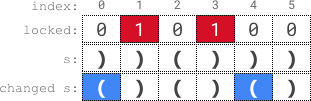
Input: s = "))()))", locked = "010100"
Output: true
Explanation: locked[1] == '1' and locked[3] == '1', so we cannot change s[1] or s[3].
We change s[0] and s[4] to '(' while leaving s[2] and s[5] unchanged to make s valid.
Example 2:
Input: s = "()()", locked = "0000"
Output: true
Explanation: We do not need to make any changes because s is already valid.
Example 3:
Input: s = ")", locked = "0"
Output: false
Explanation: locked permits us to change s[0].
Changing s[0] to either '(' or ')' will not make s valid.
Constraints:
n == s.length == locked.length1 <= n <= 10^5s[i]is either'('or')'.locked[i]is either'0'or'1'.
Solution (Java)
class Solution {
    public boolean canBeValid(String s, String locked) {
        if (s == null || s.isEmpty()) {
            return true;
        }
        if ((s.length() & 1) > 0) {
            return false;
        }
        if (locked == null || locked.isEmpty()) {
            return true;
        }
        int numOfLockedClose = 0;
        int numOfLockedOpen = 0;
        for (int i = 0; i < s.length(); i++) {
            int countOfChars = i + 1;
            if (s.charAt(i) == ')' && locked.charAt(i) == '1') {
                numOfLockedClose++;
                if (numOfLockedClose * 2 > countOfChars) {
                    return false;
                }
            }
            int j = s.length() - 1 - i;
            if (s.charAt(j) == '(' && locked.charAt(j) == '1') {
                numOfLockedOpen++;

                if (numOfLockedOpen * 2 > countOfChars) {
                    return false;
                }
            }
        }
        return true;
    }
}
Explain:
nope.
Complexity:
- Time complexity : O(n).
- Space complexity : O(n).